
Mining Power Solutions
Battery Energy Storage for Mines and Remote Processing Sites
Quick answer: Mining BESS is used to stabilize weak-grid or isolated mine power systems, support large transient loads, reduce inefficient diesel generator runtime, store solar energy and maintain reserve power for critical civilian mining operations. Correct sizing depends on the site load profile, major motor loads, generator data, PV capacity, grid reliability, backup target and environmental conditions.
How do mining hybrid power solutions combine BESS, solar and diesel generators?
For remote mines, BESS can work with solar PV and generators for mining operations to absorb load swings, reduce low-load diesel running, store excess solar energy and keep selected critical loads supported during grid or generator disturbances. The operating strategy should be based on interval load data, generator minimum loading, motor-start requirements, solar production and the required reserve or backup duration.
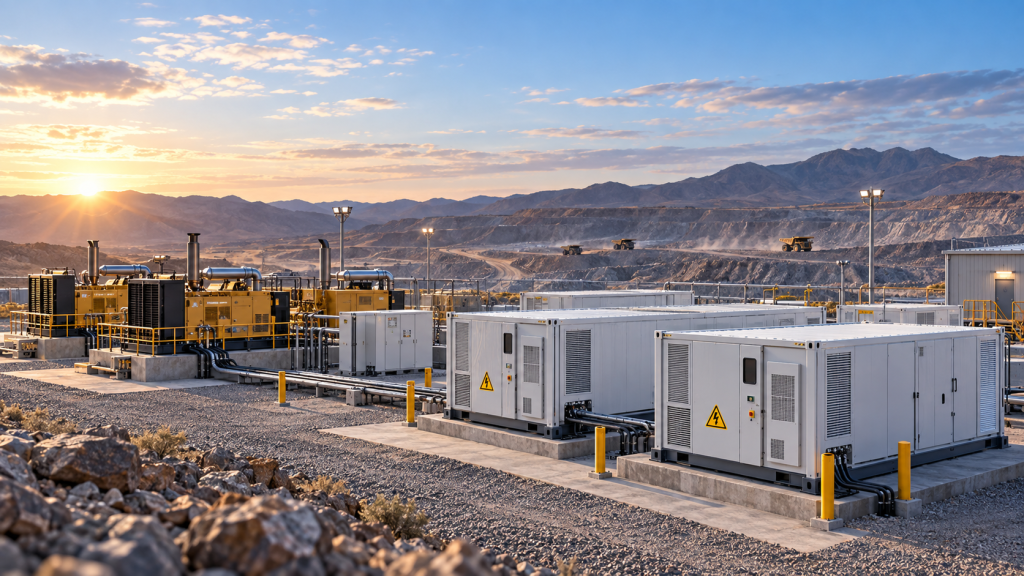
Typical applications
- Solar + Diesel + BESS hybrid power
- Peak-load support for crushers, pumps and processing equipment
- Backup power for critical production and camp loads
- Fuel reduction at remote sites
- Microgrid support for weak-grid operations
Information for system sizing
Please provide hourly or 15-minute load data, generator ratings and operating hours, PV capacity, grid availability, major motor loads, target autonomy and site environmental conditions.
Common mining-site power challenges
Remote mines may face long utility feeders, unstable grids, high diesel dependence and large intermittent motor loads. Storage can be configured to support transient demand, reduce generator runtime, capture solar energy and provide reserve power for selected critical loads.
- Support fast-changing loads from pumps, crushers and processing equipment.
- Reduce low-load diesel operation during lighter production periods.
- Store surplus PV energy for later industrial demand.
- Maintain backup reserve for critical process or camp loads.
Mining BESS design checklist
| Input | Why it matters |
|---|---|
| Load profile | Defines normal demand, peaks and operating shifts. |
| Major motor loads | Helps evaluate transient power and starting requirements. |
| Generator data | Shows current diesel capacity, runtime and redundancy. |
| Site environment | Temperature, altitude, dust and installation space influence equipment selection. |
Mining Energy Storage FAQ
Can BESS reduce diesel fuel use at a mine?
It can reduce inefficient generator runtime when the site’s load profile, battery capacity and control strategy are suitable. The expected benefit depends on actual operating data.
What operating data should a mine provide before BESS sizing?
Provide at least 15-minute or hourly load data, major motor starting requirements, diesel generator ratings and runtime, PV output if available, grid outage history, required backup duration and site temperature and altitude.
Can a mining BESS operate with both PV and diesel generators?
Yes. A hybrid control strategy can coordinate PV, battery storage and diesel generation so the BESS absorbs surplus solar energy, supports fast load changes and helps keep generators closer to efficient operating ranges.
Related technical guides
For early-stage project evaluation, see our BESS sizing guide, review our Diesel + BESS architecture, compare the wider microgrid and backup power approach, or explore our BESS solutions for mining and industrial power in DRC.
Review the modular 215kWh BESS or the larger 1MWh battery energy storage system, or explore our Microgrid & Backup approach, then send your load and site data for a project-specific configuration.
Get BESS Sizing & Quotation
Send the key project inputs below. Zevonexa will review the application, target power and energy, grid or generator conditions and prepare a project-specific response.
How do you size a hybrid power system for a mining site?
Start with the mine’s interval load profile, peak demand, critical loads, generator ratings and fuel consumption, solar resource and PV capacity, grid availability, required autonomy and expansion plan. Battery power (kW/MW) must cover the required instantaneous duty, while battery energy (kWh/MWh) is selected from the required operating duration and usable-energy assumptions. A mining project focused on generator fuel reduction therefore needs a different power-to-energy ratio from a project focused on long-duration backup.
For procurement planning, use the BESS Buyer Guides and BESS sizing guide. Smaller modular projects can review the 215kWh BESS; larger industrial loads can review the 1MWh BESS; weak-grid and off-grid mines should also review Microgrid & Backup Power.
Get an instant preliminary kW/kWh estimate before sending the RFQ.
Mining Hybrid Power FAQ
What is a mining hybrid power system?
A mining hybrid power system combines two or more power sources—commonly grid, diesel generation, solar PV and BESS—under a coordinated operating strategy. The appropriate architecture depends on the mine load profile, outage pattern, generator fleet and operating objective.
How is BESS sized for a remote mine?
Start with interval load data, continuous and peak demand, largest motor loads, critical-load requirement, generator ratings, PV capacity and required autonomy. Size battery power (kW) and energy (kWh) separately. See the mining BESS sizing guide, review BESS for mining and industrial power in Zambia, or use the BESS sizing calculator.
Can BESS completely replace diesel generators at a mine?
Not automatically. Whether generators can be reduced or removed depends on load, renewable-energy availability, required autonomy, grid access, redundancy and operating constraints. For many remote sites, a hybrid architecture is the more appropriate starting point for engineering review.