
Hybrid Power for Remote Sites
Diesel + BESS for Lower Fuel Use and Better Generator Operation
Quick answer: Diesel + BESS combines battery energy storage with diesel generators so the battery can carry suitable loads, respond to short power peaks and reduce inefficient low-load generator operation. For remote industrial and off-grid civilian sites, the correct BESS size depends on generator rating, load profile, daily runtime, fuel use, existing solar capacity and required backup duration.
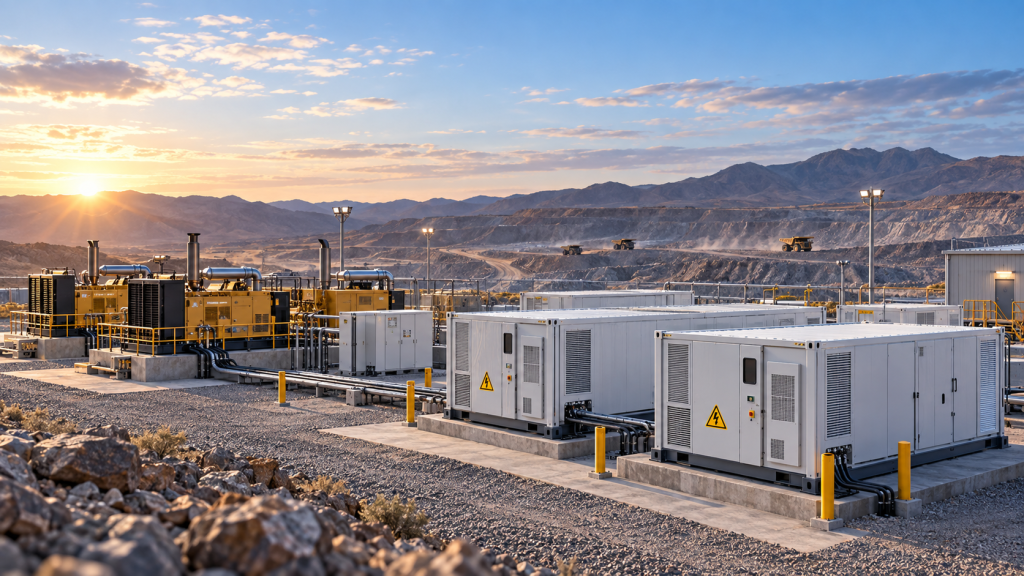
Key Benefits of Diesel + BESS
Reduce Generator Runtime
Use stored energy to carry suitable loads instead of keeping gensets online continuously.
Improve Fuel Efficiency
Keep generators closer to efficient operating ranges and reduce low-load operation.
Fast Response
Battery power can respond rapidly to transient loads while supporting stable site operation.
Project data required
Send generator quantity and rating, typical loading, daily fuel consumption if available, load profile, existing PV capacity, desired backup time and site location. We will configure the hybrid power architecture around the actual operating profile.
Why combine batteries with diesel generators?
Diesel generators are often inefficient when they operate for long periods at low load or repeatedly follow short power peaks. A properly configured BESS can carry suitable loads, absorb rapid demand changes and allow generators to run closer to efficient operating ranges. The result can be lower fuel consumption, fewer operating hours and more stable power quality.
- Reduce generator low-load operation and unnecessary runtime.
- Respond quickly to transient loads and motor-starting events.
- Store solar energy when PV is added to the hybrid system.
- Maintain reserve energy for critical loads and generator transitions.
How to size a Diesel + BESS hybrid system
Power (kW) and energy (kWh) must be sized separately. PCS power is driven by the load the battery must carry, peak shaving target, motor starts and transient support. Battery energy is driven by how long that power must be supplied, the operating SOC window, conversion losses, reserve requirement and expected cycling. Generator kVA alone is not enough to select a BESS.
Screening logic: start with the measured load profile and define the operating objective: reduce low-load generator hours, absorb short peaks, shift solar energy, provide spinning reserve, or supply a defined backup period. Then verify generator minimum-loading constraints, controls, switchgear, voltage/frequency, black-start or islanding requirements and the site expansion plan before final equipment selection.
Hybrid system design inputs
| Input | Why we need it |
|---|---|
| Generator ratings | Shows available power, loading range and redundancy. |
| Fuel and runtime data | Helps identify the operating periods where storage can create value. |
| Load profile | Defines continuous demand, peaks and fast-changing loads. |
| PV capacity | Allows Solar + Diesel + BESS operation to be considered when renewable energy is available. |
Diesel + BESS FAQ
How do you size a battery for a diesel generator?
Do not size the battery from generator kVA alone. Use time-series load data to determine the kW the battery must carry and the duration of that duty to determine kWh. Then apply the intended SOC window, conversion losses, reserve margin and cycling strategy, and verify the generator control and minimum-loading requirements.
When does Diesel + BESS make the most sense?
It is most worth evaluating where generators spend significant time at low load, site demand has short peaks, solar energy would otherwise be curtailed, or the operator needs fast reserve and quieter battery-only operating periods. Savings must be calculated from the actual load and fuel data rather than assumed percentages.
Does BESS completely replace the diesel generator?
Not necessarily. In many remote projects, the battery and generator operate together. The correct balance depends on load profile, autonomy target, renewable generation and the required level of redundancy.
Can the system be added to an existing generator plant?
Yes, subject to technical review. Generator controls, switchgear, voltage architecture and site operating logic need to be evaluated before integration.
Diesel + BESS sizing guide · BESS sizing calculator · Solar + BESS · Mining energy storage · Remote industrial / EPC power · Oil & Gas BESS solutions
Review the modular 215kWh BESS or the larger 1MWh battery energy storage system, then send your load and site data for a project-specific configuration.
Get BESS Sizing & Quotation
Send the key project inputs below. Zevonexa will review the application, target power and energy, grid or generator conditions and prepare a project-specific response.
Get an instant preliminary kW/kWh estimate before sending the RFQ.